
An inside look at how quality graphite transforms the crucible industry
A Conversation with Industry Expert Rajesh Sharma
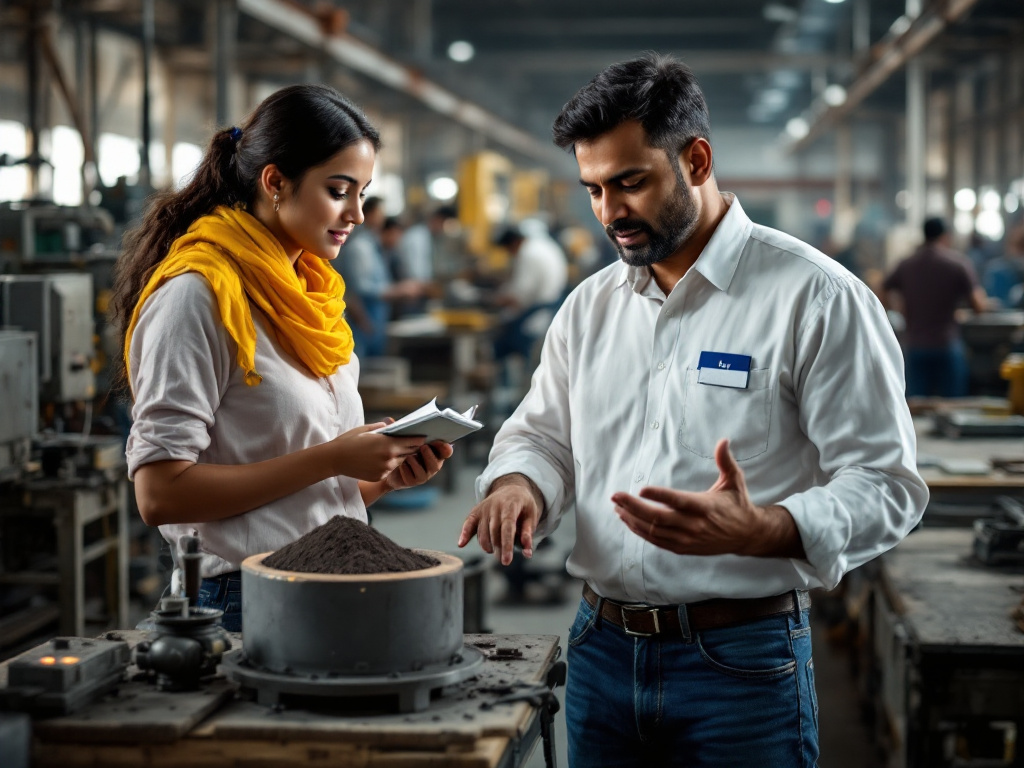
When graduate student Priya Patel (name changed) decided to focus her materials science thesis at IIT Bombay on high-temperature applications of carbon materials, she knew she needed insights from industry professionals. After extensive research, she arranged a visit to Bharat Precision Crucibles (name changed), where production manager Rajesh Sharma (name changed) has overseen operations for over two decades.
“I’ve been working with crucibles since before you were born,” Sharma ji laughs as he guides Priya through the facility’s busy production floor in Pune. “But I never get tired of explaining why graphite is absolutely irreplaceable in what we do.”
Priya observes workers carefully mixing materials for a new batch of crucibles. “So I get that graphite is important here,” Priya says, raising her voice slightly over the background noise of the factory floor, “but I’m curious – have you tried experimenting with other carbon materials?” She adjusts her safety goggles. “My professor mentioned silicon carbide applications…”
The Unique Properties That Make Graphite Essential
Sharma ji picks up a sample of flake graphite from a nearby workstation. “This isn’t just any carbon material,” he explains, letting the silvery flakes catch the light. “Natural graphite has a unique crystalline structure that gives it properties no synthetic substitute can fully replicate.”
He leads Priya to a workbench where he demonstrates graphite’s properties:
“First thing to understand,” Sharma ji begins, wiping sweat from his forehead with a handkerchief, “graphite handles heat like nothing else. We’re talking—” he pauses, searching for the right words, “exceptional stability when everything else would just… fall apart. These crucibles?” He taps one with his knuckle. “They’re dealing with metals at, what, 1200, sometimes 1500 degrees. Especially brutal during summer months when the whole factory feels like an oven itself.”
Priya notes this down. “What about thermal conductivity?”
“Exactly!” Sharma ji nods approvingly. “Graphite has excellent thermal conductivity, which ensures uniform heating of the metal charge. This prevents hot spots that could compromise the crucible or affect metal quality. It’s particularly crucial for our jewelry manufacturing clients in Surat and Rajkot, where precision is paramount.”
As they walk past a testing area, Sharma ji continues: “Then there’s thermal shock resistance—the ability to withstand rapid temperature changes without cracking. When you’re pouring molten metal for temple idols or industrial components, you can’t afford failure.”
From Raw Material to Finished Product
The tour moves to the raw materials section, where different grades of graphite are stored in clearly labeled containers.
“The quality and type of graphite dramatically affects crucible performance,” Sharma ji explains. “We use specific blends of flake and amorphous graphite depending on the application. For aluminum casting for automotive parts in Chennai’s manufacturing belt, we might use a different blend than for gold melting in Kolkata’s traditional workshops.”
Priya examines samples of different graphite flake sizes. “How do you determine the right mixture?”
“That’s where the science comes in,” Sharma ji says, then suddenly checks his watch. “One minute—” He calls out instructions in rapid Hindi to a worker who’s mixing a batch incorrectly. Turning back to Priya, he continues, “Sorry about that. New hire. Where was I? Right—larger flakes. Like making good chai, actually. You want the right tea leaf size—too large and it doesn’t release flavor properly, too fine and you get sediment. Same principle with graphite flakes. The larger ones give you better heat transfer and resist oxidation, but use too many and the structural integrity…” he makes a crumbling motion with his hands.
He shows Priya a cross-section of a crucible wall. “See these layers? We incorporate different graphite concentrations throughout the crucible wall, with the highest quality, largest flakes concentrated where they’ll contact molten metal.”
Beyond Basic Performance: Why Quality Matters
At the quality control station, technicians are testing finished crucibles. “We don’t just make containers that hold hot metal,” Sharma ji emphasizes. “Graphite quality directly affects metal purity, energy efficiency, and crucible lifespan.”
Priya watches as a technician measures the density of a finished crucible. “How so?”
“Impurities in lower-grade graphite can leach into the melt, compromising metal quality—devastating for clients in ISRO’s space program or medical implant manufacturing in Bengaluru,” Sharma ji explains. “Premium natural graphite has fewer impurities than synthetic alternatives.”
He points to energy consumption data displayed on a nearby monitor. “Higher-quality graphite improves thermal efficiency, reducing energy costs by up to 10-12%. When you’re running furnaces 24/7 and dealing with power supply considerations, that’s significant for our bottom line.”
“What about environmental concerns?” Priya asks.
“Valid question. Quality graphite crucibles last longer—sometimes three times longer than inferior products. Fewer replacements mean less waste and reduced resource consumption. We’ve found that using premium graphite actually reduces our carbon footprint despite the higher initial material cost. This aligns with our commitment to sustainable manufacturing practices and the government’s Make in India initiative.”
Innovation and the Future of Graphite in Crucibles
The final stop is the R&D lab, where prototypes of next-generation crucibles are being tested.
“We’re constantly pushing boundaries,” Sharma ji says, showing Priya a crucible with a complex inner geometry. “This design incorporates nano-enhanced graphite layers that further improve performance for specialized applications. We’re working with researchers at IISc Bangalore on these innovations.”
Priya examines the prototype. “Are there supply concerns with natural graphite?”
“There are challenges,” Sharma ji acknowledges. “Premium natural graphite sources are limited, and demand is increasing across industries, from crucibles to electric vehicle batteries. That’s why relationships with reliable suppliers are crucial, especially since India imports much of its high-grade graphite.”
“We’re trying different approaches to be smarter about graphite usage,” Sharma ji says, looking somewhat uncomfortable. “I should admit, we don’t have all the answers yet. Our processing has improved, we’re playing with new designs…” He gestures vaguely at the prototypes. “Sometimes placing premium graphite strategically works, other times it causes unexpected problems. Research is messy. Three months ago we thought we had a breakthrough, then all the samples failed stress testing.” He laughs. “My boss wasn’t happy about that investment.”
Taking Knowledge Back to Academia
As the tour concludes, Priya has filled several pages with notes. “This has been incredibly valuable for my research,” she tells Sharma ji. “I understand now why textbook knowledge only scratches the surface.”
Sharma ji smiles. “That’s why I enjoy these visits. The theory is important, but seeing how graphite performs in real-world applications gives you perspective you can’t get from academic papers alone. This is why we support internships for students from IITs and NITs.”
Priya has one final question: “What would you tell someone who’s considering cheaper alternatives to natural graphite in crucible manufacturing?”
“Look, let me tell you something,” Sharma ji says, his voice dropping slightly. “Early in my career, I was under pressure to cut costs. We tried a cheaper graphite supplier for a big order of crucibles going to an automotive client in Pune. Three weeks later, I’m getting phone calls at 2 AM because half their batch failed mid-pour. Hot metal everywhere.” He shakes his head at the memory. “I spent the next month personally visiting their facility, rebuilding our reputation. So when I say the graphite you choose matters, it’s not just talk. When your business depends on consistent performance under the worst conditions, that graphite isn’t just an ingredient—it’s everything. ‘Sasta roye baar baar, mehnga roye ek baar’ [The cheap option makes you cry repeatedly, the expensive one only once].”
This article was prepared by the technical team at Momentum Minerals, suppliers of premium-grade natural graphite to crucible manufacturers worldwide. For more information on our graphite products specifically formulated for crucible applications, contact our materials specialists.
Leave a Reply